
Tackling the U.S. National Debt: Pick Your Poison, America
/h2 >
The most pressing issue facing the U.S. economy is deficit spending and the growing national debt… that’s where the policy focus should be.
- Economic Policy, Economics, General Economy
- December 21, 2023
- Author: Christopher Thornberg, PhD

Christopher Thornberg, PhD
Author

Our collective worries right now seem misplaced.
We worry about oil prices, but the U.S. is the world’s top oil producer, so higher prices also mean higher domestic profits. We worry about having “too much” immigration, but birth rates are falling and immigrants support a growing workforce. And with tariffs, much of the concern has been about inflation, yet they’ve also generated meaningful federal revenue.
Meanwhile, the thing we should be paying much closer attention to—the federal budget—doesn’t get nearly the same focus. Our spending is out of line.
This isn’t to say tariffs are the solution. But they have provided some revenue at a time when the current and future U.S. deficit is becoming harder to ignore.
Tariff Worries
Before ‘Liberation Day,’ many economists worried that the new tariffs would be detrimental to the economy. That concern didn’t come out of nowhere. The U.S. has operated under relatively free trade for decades, so a major shift away from that framework was certainly going to raise concerns. And more broadly, economic theory has long pointed to the benefits of free trade. In fact, despite disagreeing on many things, economists have historically been fairly unified on this point.
The reasoning is straightforward. Free trade allows countries to focus on their comparative advantages, increasing overall production and welfare across trading partners. Of course, within each country there are winners and losers. Producers that must now compete with overseas firms are often the “losers,” as they are forced to price more competitively. The winners, by contrast, are those firms that gain access to a larger market, selling not only to domestic consumers, but also to consumers overseas. This idea runs counter to the simpler instinct or intuition that views trade as zero-sum: if you win, I must be losing. [1] But economics teaches us that there are ways to grow the overall pie… and free trade is one way to do that.
Prices and Trading Partners
So what actually happened after the tariffs were enacted? Surprisingly, not much in terms of the predicted negative effects. We haven’t seen the dramatic price spikes many feared, and overall trade volumes have remained fairly stable. The annual change in the Consumer Price Index was 2.9% in 2024 and a bit lower in 2025 at 2.6%.
That said, trade growth has slowed for real imports of goods. Imports have declined 2.7% year-over-year as of the 4th quarter of 2025. This followed a surge ahead of Liberation Day as firms rushed to bring in goods before the tariffs took effect. Since then, imports have fallen below typical levels. This could be, at least in part, a reflection of the fact that inventories are already high.
By contrast, real exports of goods don’t appear to have been significantly impacted by tariffs. Additionally, this type of movement in imports is not unprecedented. Even before the pandemic (Q4 2019), the United States experienced similar year-over-year declines in the real value of imports. Compared to the relatively extreme predictions about trade disruptions, a slowdown in import growth is far less dramatic.
What has changed, however, is the composition of our trading partners. There’s been a (continued) [2] shift away from mainland China in both exports and imports. U.S. exports to China fell to about $106 billion in 2025, down from $143 billion in 2024 (and $148 billion in 2023). Imports declined more sharply, dropping from just over $400 billion in both 2023 and 2024 to slightly above $300 billion in 2025.


Federal Revenue and Deficit Spending
But probably the most important part of the story is the tariffs’ impact on federal revenue. The Trump administration has continued to highlight that effect, even going so far as to suggest that tariff revenue could mean no more income taxes. While that’s clearly an exaggeration, the focus on revenue isn’t entirely off base. At a time when the federal government continues to run enormous deficits, this added source of revenue actually matters.
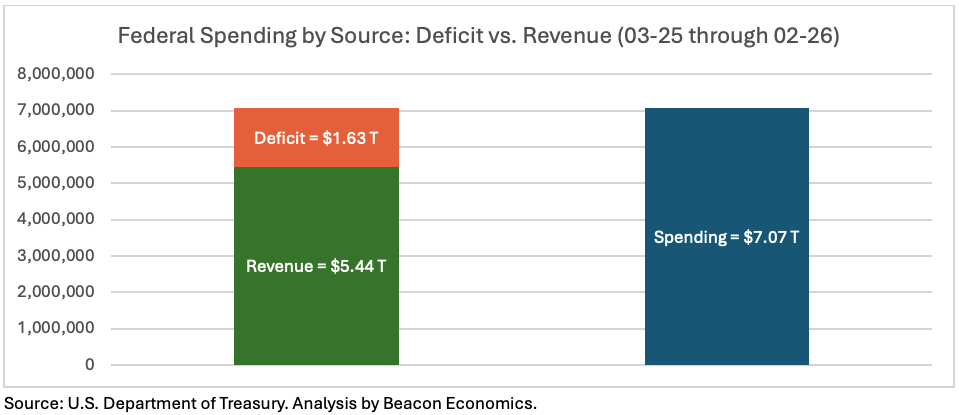
Like it has for many consecutive years, the U.S. government is deficit spending once again this year. According to the U.S. Treasury Department, in FY 2025 federal spending totaled approximately $7.01 trillion, while revenues were $5.23 trillion, resulting in a deficit of $1.78 trillion. In other words, roughly one out of every four dollars of federal spending is financed through borrowing.
And because the so-called ‘Liberation Day’ tariffs were recently ruled unconstitutional by the Supreme Court [3], deficits are expected to grow even more. The Congressional Budget Office (CBO) estimates that these reductions will increase deficits by roughly $2.0 trillion over the next decade. This includes $1.6 trillion in higher primary deficits and $0.4 trillion in additional debt-service costs. Similarly, the Committee for a Responsible Federal Budget (CRFB) estimates a $1.7 trillion revenue loss.[4]
However, the 10 percent global tariff imposed in response to the ruling—effective February 24, 2026, and currently set to expire on July 24, 2026 [5]—would offset a meaningful share of these losses.[6] According to CRFB estimates, those tariffs are expected to cover just over half of the revenue losses within the 150 days they are in effect, and if extended beyond the 150-day window, they would generate roughly $925 billion in federal revenue over the next decade. In other words, they would offset a substantial portion (54%) of the roughly $1.7 trillion in projected revenue losses tied to tariff reductions.

Higher Deficits Means More Debt
Debt is the accumulation of all past deficits and surpluses. And so, more deficit spending adds to the existing national debt figure. More important than just looking at the absolute number, is how debt stands relative to GDP. Since GDP generally keeps growing, it’s “OK” for debt to grow as well – as long as the ratio doesn’t increase (preferably, it’s decreasing).
While the debt-to-GDP ratio peaked at about 106% following World War II, it is now hovering right around 100%, according to the CBO, and is projected to reach roughly 120% ($56 trillion) over the next decade. Importantly, this projection does not include the removal of ‘Liberation Day’ (International Emergency Economic Powers Act or IEEPA) tariffs. Replacing those with the 150-day tariffs imposed in February 2026, the debt-to-GDP ratio could be even higher, at around 125% ($58 trillion). Of course, if these tariffs are not renewed after the 150 days then we can expect debt-to-GDP to be higher yet. [7]
More relevant than the ratio of debt-to-GDP however, is the actual burden the debt places on the federal government in real time. Debt itself does not need to be repaid immediately, but the interest on the debt does. That is the ongoing cost of borrowing. For much of the 20th century, this burden was manageable, as the average interest rate on federal debt remained below the rate of economic growth.
Since the pandemic, however, interest payments have increased sharply, not just in absolute terms, but relative to the size of the economy. When adjusted using the implicit GDP deflator and expressed as a share of GDP, interest payments have risen from roughly 1.5% to over 3% in 2025. While this range is not unprecedented – it was also observed from the mid-1980s through the mid-1990s – those increases were largely the result of deliberate monetary policy. Under Federal Reserve Chair Paul Volcker, interest rates were raised significantly to fight inflation, with the understanding that this would temporarily increase the federal government’s debt burden.


Why Should We Care?
It’s easy to think of federal debt as Washington’s problem. But there are two critical reasons Americans should pay attention. First is that the federal budget funds programs we rely on like Social Security, Medicare, Medicaid, and highways. The CBO projects that the Highway Trust Fund could run out soon, Social Security’s trust fund could be depleted around 2032 (triggering automatic benefit cuts), and Medicare around 2040. Those projections assume current law remains unchanged. Without tariff revenue, those timelines could accelerate.
Second, if the nation’s debt—or even just the interest on that debt—reaches unsustainable levels, it could lead to a debt spiral or broader fiscal crisis. At its core, that risk comes down to a loss of confidence in the U.S. government’s ability to repay what it owes. The federal government relies on continued borrowing to fund both its deficits and its interest on existing debt. If that confidence weakens and investors become less willing to lend, borrowing costs rise, and in a worst-case scenario, the government could struggle to meet its obligations as they come due. That would be a serious problem.
What’s the Solution?
Again, none of this is to argue that tariffs are the ideal policy solution. But in an environment of declining birth rates and increasingly restrictive immigration policies (the CBO projects that net immigration could fall to zero in 2026 and remain low thereafter), this revenue source matters. And despite the general sense of noxiousness and near-visceral abhorrence of higher income taxes (to put it mildly), the public tends to be far more neutral about tariffs.
Part of that may be perception. Tariffs are often thought to only affect foreigners—even though in practice they tend to invite retaliation from trading partners. It may also be familiarity. Tariffs have been part of the U.S. fiscal system since the country’s founding,[8] originally serving as a primary source of federal revenue, whereas income taxes are a much more recent development, only permanently established with the 16th Amendment in 1913.[9] Whether that history drives acceptance, or acceptance explains their persistence, is not entirely clear.
One option – given these constraints – would be to extend the blanket tariffs beyond the initial 150 days. But are we actually comfortable with that? Or will worries about higher prices resurface, even though those effects haven’t meaningfully shown up in the data so far?
The alternative, of course, is to raise taxes across the board. But are Americans willing to pay higher income taxes? And is it realistic to expect elected officials to support higher income taxes and stay in office?
The reality is that the United States has to pick its poison. We’re up against a wall with the debt, and neither higher income taxes nor more tariffs will be universally popular. Beyond raising revenue, the remaining options are to reduce spending or rely on growth.
Spending cuts are one path—at least in theory—but given the trajectory of spending relative to revenues, it seems unlikely, leaving just growth, which we often point to as a way out of fiscal imbalances. But growth doesn’t just happen; it comes from either labor force expansion or productivity gains. U.S. labor force growth is already constrained by falling birth rates and lower immigration, and while productivity growth had been relatively sluggish for much of the past decade, it has picked up more recently—though not yet at a pace that would meaningfully alter the long-run fiscal outlook. Are we willing to ease immigration policy? Or meaningfully change demographic trends?
At this point, we may be quietly hoping that AI saves the day. Or at least delivers the kind of sustained productivity gains that could actually move the needle. But more importantly, it brings us back to where we started: are we worrying about the right things? Because if the most pressing issue is deficit spending and the growing national debt, then that’s where the focus should be—and not on the distractions that dominate so much conversation today.
–
[1] Meegan, D. V. (2010). Zero-sum bias: Perceived competition despite unlimited resources. Frontiers in psychology, 1, 191.
[2] This shift was already underway during the first Trump administration, as U.S.–China trade tensions escalated in 2018–2019.
[3] In a 6–3 ruling, the Court found that the tariffs went beyond the president’s authority under a 1977 statute permitting the regulation of commerce in response to foreign threats during national emergencies.
[4] The CRFB estimate assumes the distribution of tariff refunds, while the CBO estimate assumes none; in practice, refunds are now being implemented following the Supreme Court’s ruling.
[5] Implemented under Section 122 of the Trade Act of 1974, which authorizes the President to negotiate trade agreements, reduce trade barriers, and respond to unfair foreign trade practices, and established “fast-track” authority (now Trade Promotion Authority) for congressional approval without amendment.
[6] These estimates exclude the additional tariffs on steel, aluminum, and copper imports introduced in April 2026.
[7] The President’s Budget assumes relatively strong economic growth (around 3% annually), which contributes to more favorable debt projections. It does not present clear summary figures for debt or deficits, requiring them to be inferred from underlying tables. Based on those estimates, debt rises modestly before declining to roughly 94% of GDP by 2036. These projections differ from CBO estimates in part because CBO assumes slower long-term growth, highlighting the sensitivity of debt outcomes to underlying economic assumptions.
[8] U.S. tariffs have been in place since the country’s founding, initially serving as a primary source of federal revenue. Over time, they were increasingly used for protectionist purposes, particularly in the late 19th and early 20th centuries, before generally declining after the 1930s with the expansion of global trade agreements. Source: U.S. Department of State, Office of the Historian; Hillsdale College.
[9] U.S. income taxes were initially enacted during the Civil War (1861–1872) and briefly reintroduced in 1894, though the latter was ruled unconstitutional. A permanent federal income tax was not established until the 16th Amendment was ratified in 1913, followed by the first modern income tax law and Form 1040 in 1914. Source: U.S. Internal Revenue Service.
No Nonsense Economics
 See more
6 August
U.S. Labor Market Fears and the Global Equity Swoon
- See more
30 April
Surge Pricing Vs. Dynamic Pricing: What’s In A Name? As It Turns Out, A Lot!
- See more
17 April
Surveys and the Economy—What They Do and Don’t Tell Us
- See more
21 December
The Changing Patterns Of Holiday Spending
 See more
 See more
 See more
 See more
More Information
Business Development Team
at 424-372-1061 or [email protected]