
October 16, 2026
Beacon Employment Report | California
Presented by Beacon Economics
Copyright © Beacon Economics LLC
Beacon Economics publishes a variety of online reports that analyze and forecast the U.S., California, and California regional economies. These publications provide users with the latest data, and with substantive commentary on the overall direction of the economy, employment and unemployment, international trade, real estate markets, consumer and business spending, and much more. The reports represent only a sampling of the kind of analysis Beacon Economics produces.
California's Shrinking Labor Force Could Make Hiring Difficult
Job Growth Contracts In Latest Numbers


9,300
Monthly Job Loss
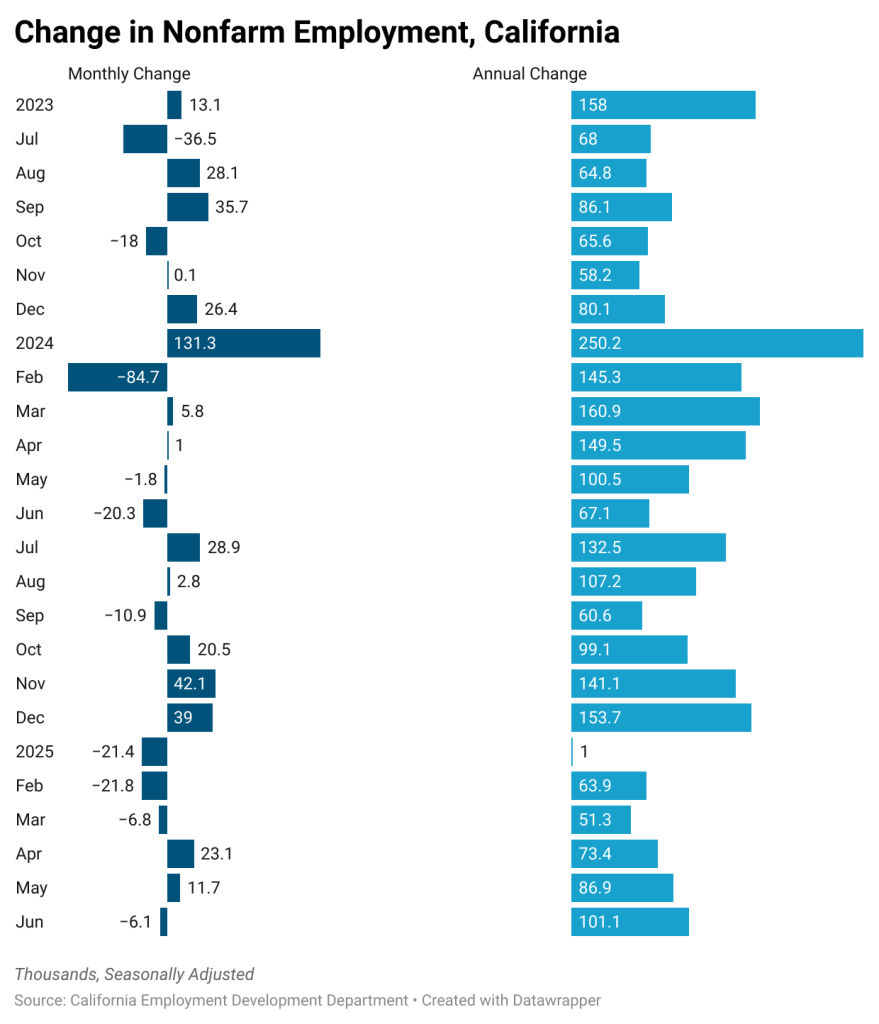
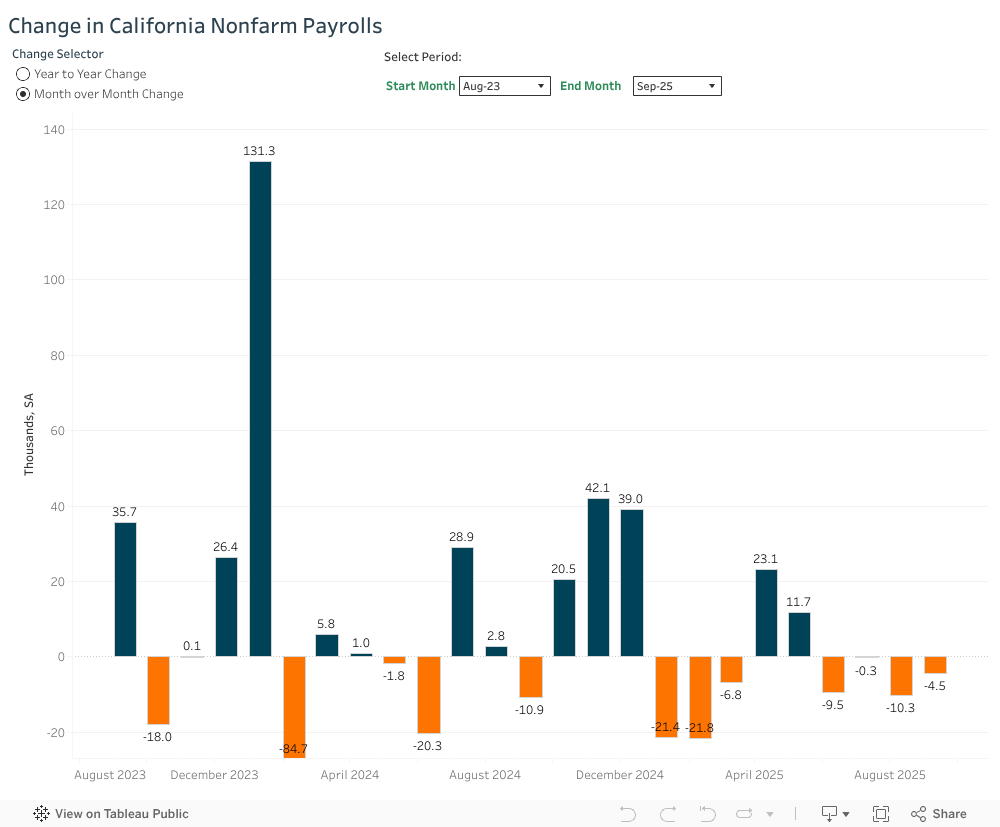
California’s nonfarm payroll jobs contracted in September. Total nonfarm employment in the state fell to a seasonally adjusted 18,151,600, a decline of 9,300 positions over the month. Additionally, August’s job gains were revised down by 16,300 positions from the initial estimate. As a result, employment grew by just 23,100 from July to August instead of 39,400.
Annually, from September 2025 to September 2026, California increased payrolls by 0.7%, outpacing the 0.3% gain nationally over the same period. The state’s labor market continues to be supported mostly by locally serving industries such as Health Care, Retail Trade, and Education. Without the sizeable gains in Health Care, employment levels would be up just 0.2% over the last year.
5.1%
Unemployment Rate
California’s unemployment rate went unchanged in September at 5.1% and remains amongst the highest in the nation even though it has fallen by 0.4 percentage-points over the last year (the nation’s rate is down just 0.2 percentage-points). However, given the limited job gains, declining unemployment is being driven by a contracting labor force rather than a strong job market (as described in Beacon Economics’ latest California Outlook).
“Employers should not assume slower job growth will make hiring easier – California’s labor force is shrinking, so it may be difficult to fill particular roles,” said Stafford Nichols, Research Manager at Beacon Economics. “In addition to the broader employment numbers, businesses need to assess the availability of workers who have the skills they require.”
20,900
Labor Supply Decline
The labor force has trended down in both California and the United States this year. Month-over-month, the state’s labor supply fell by 20,900, or -0.1%. Over the past year, it’s fallen by 378,600 workers, a 1.9% contraction and a steeper decline than the 0.6% drop at the national level. An aging population, California’s chronic housing shortage, and lower levels of international migration to the United States continue to limit labor supply growth.
(If you are unable to view the graphics in the Beacon Employment Report, please check your cookie settings.)
The Beacon Employment Report | California is a unique analysis of California’s employment numbers and trends. Each month, we link our own econometric predictions to data released by the U.S. Bureau of Labor Statistics and the California Employment Development Department to identify important changes in employment across industries and regions. The Beacon Employment Report is also one of the few analyses that uses seasonally adjusted numbers, which are critical to revealing accurate trends and insights within data. The analysis is a sample of the kind of research available from Beacon Economics.
The contents of this report are based on information derived from carefully selected sources Beacon Economics believe are reasonable. We do not guarantee its accuracy or completeness and nothing presented here shall be construed to be a representation of such a guarantee.
More
Information
For information about Beacon’s practice areas, please contact:
Business Development Team at [email protected]
or 424-666-2165